System One as a Judge: How We Augmented Three Production Setups
There is a new boom of System One models like Jev and Clef. Here is how we used them as judges across three use cases to augment our production setups.
There is a quiet boom happening around System One models.
While frontier labs compete on general-purpose chat and heavy multi-step reasoning, a new wave of specialized engines — models like Jev, Clef, and emerging typed evaluators — has quietly arrived.
Instead of generating paragraphs of conversational prose, these models do one thing remarkably well: they act as fast, intuitive semantic judges. They evaluate data in milliseconds and return a typed decision with a calibrated probability for fractions of a penny.
What is a “System One” model? (In Plain English)
In cognitive science, System One describes fast, automatic pattern recognition — like recognizing a familiar face across the street or gauging a driver’s speed at a glance. System Two is slow, deliberate reasoning — like solving a complex math problem or writing an essay.
Most popular LLMs (like ChatGPT or Claude) are built as general-purpose conversational or deep-reasoning engines. System One models do not chat, tell stories, or write code. They look at structured data, match patterns in milliseconds, and return a clean, typed verdict with a calibrated confidence number (such as “Yes, with 88.0% probability”).
We started experimenting with System One models as judges across our production workflows. Rather than replacing our existing infrastructure, we used them as an augmentation layer: sitting between deterministic rules and human decision-makers.
Here are three distinct use cases where we plugged them in, the exact mechanisms we used to incorporate them, and how they augmented each setup.
Use Case 1: The Rule Enforcer (System One + Deterministic Rules)
The Setup & The Bottleneck
We have a pipeline where we identify potential clients based on market signals and look for people with decision-making power to reach out to.
To qualify these contacts, you start with deterministic rules: priority titles to target (Tier 1 down to Tier 4), target departments, and titles to strictly avoid. Traditional code checks the text. It is fast, exact, and easy to test.
Then reality hits:
- The rule looks for
VP Operations. It misses someone who wroteVP Ops. - Someone has a mixed title like
Head of Operations and Legal— half a role you want, and half a department you exclude. - Your rule lists
CTO, but skips the person who wrote outChief Technology Officer.
Code matches letters, not meaning. You cannot maintain regex for every job title on earth. But letting a conversational AI decide on its own is slow, expensive, and drifts over time.
The Mechanism
We kept our rules, but gave them an intuitive semantic judge:
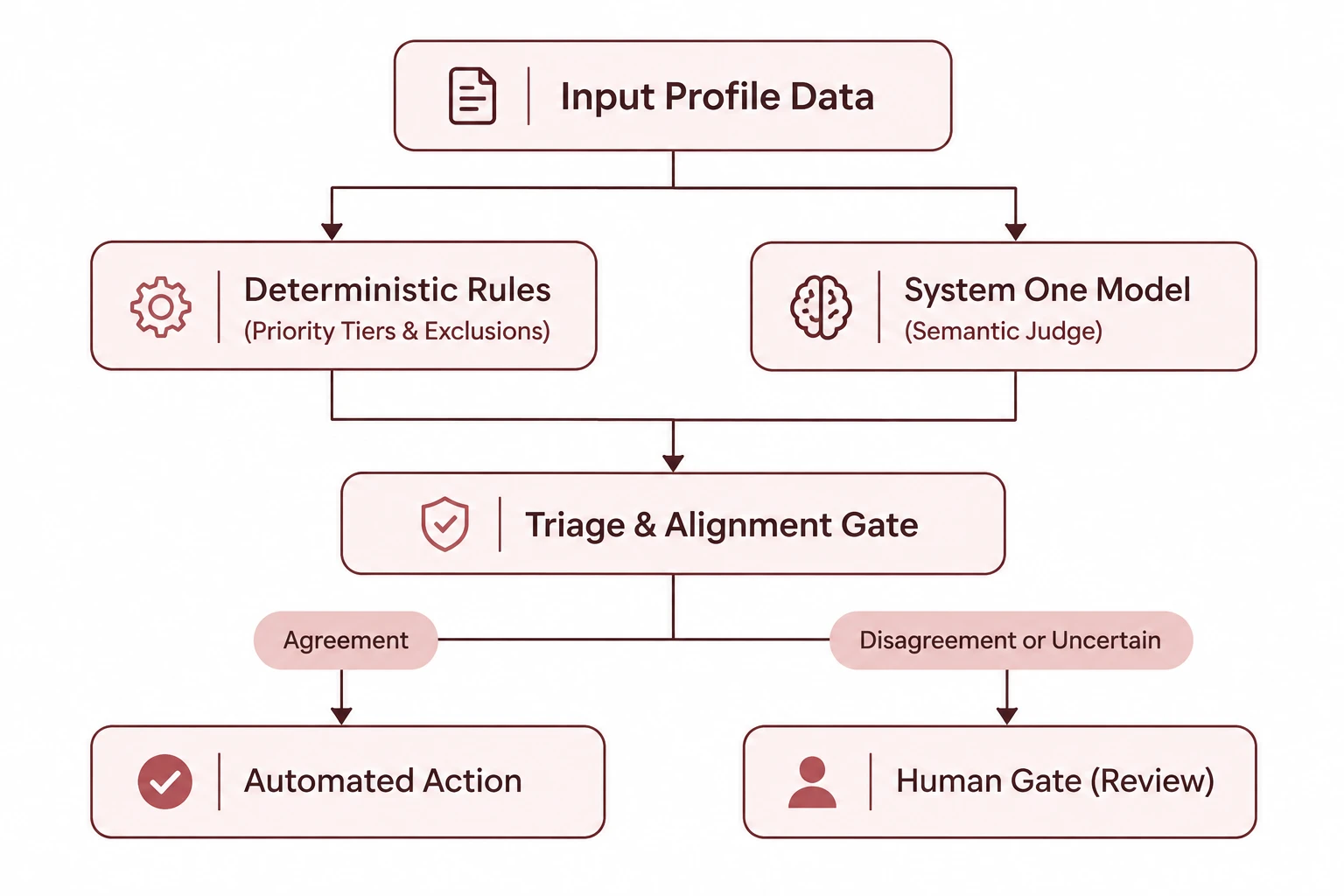
- Rules Decide What They Can: Code checks the role against inclusion and exclusion lists first.
- System One Checks the Meaning: The model evaluates three typed primitives:
noul:is_eligible(Yes/Nowith a calibrated probability from )choice:assigned_tier(picks one option:Tier1throughTier4)score:seniority(rates the role on a scale from entry to executive)
- The Rules Travel with the Request: Our inclusion and exclusion lists travel with every prompt. The model checks compliance against our explicit rules, nothing else.
- Rescuing Strong Leads: This is where our real value comes from. Rigid string rules often drop great candidates over trivial phrasing. If our rules overlook a strong match but the model is confident, a human reviewer gets the final say to rescue the lead.
- The Confident “No” Veto: If the model is confident a contact is a non-fit, we drop it automatically. When seniority is weak or borderline, dropping it keeps the review queue clean.
How It Augmented the Setup
- Rescued High-Value Candidates: Reduced false negatives by catching strong potential clients that rigid keyword matching dropped, recovering valuable opportunities.
- Cut Review Workload by 60%: Automatically filtering out confident non-fits pruned the manual review queue by over 60%.
- Zero Policy Drift: Because the business rules travel inside the request, the model never made arbitrary decisions outside our defined criteria.
Use Case 2: The Candidate Ranker (System One + Semantic Search / RAG)
The Setup & The Bottleneck
You have a software project with thousands of manual and exploratory test cases. A developer changes 50 lines of code across three files. Which tests should QA run?
Running all 3,000 tests takes days. But simple keyword matching fails completely:
- A developer writes:
optimize retry on network timeout. - The test case is titled:
verify transaction recovery after connection drop.
They mean the exact same behavior, but share zero words.
You cannot dump 3,000 test cases into a massive LLM prompt on every commit. It is slow, costs a fortune, and pollutes the context window.
The Mechanism
We combined vector search (RAG) with high-speed parallel System One scoring:
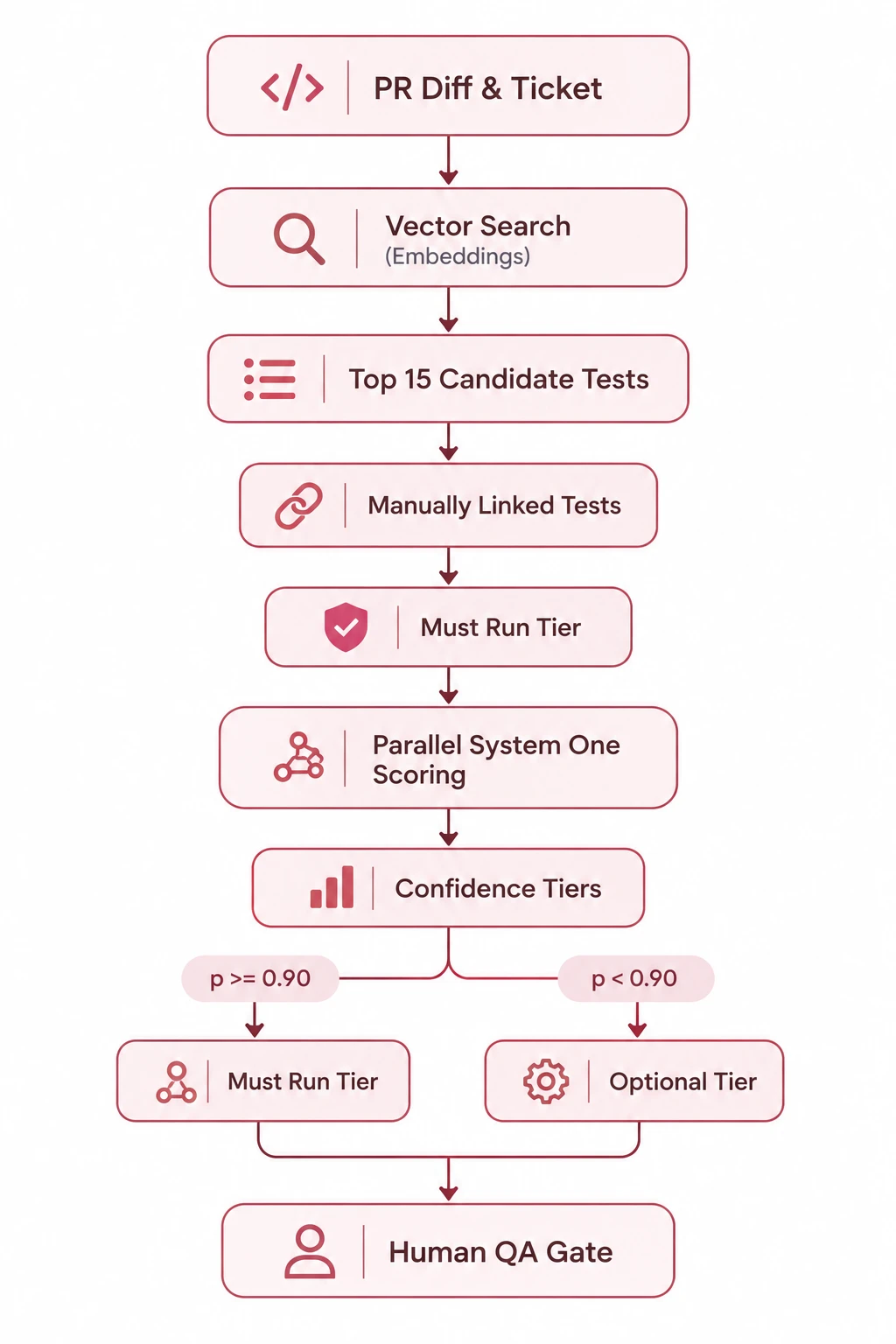
- Search Finds the Candidates: We embed the code diff and pull the top 15 nearest test cases from a vector index.
- People’s Choices Stay Fixed: Any test a QA engineer previously linked to the ticket skips the AI. It is marked as
Must Runby default. - Parallel Scoring in 1 to 2 Seconds: All 15 candidates go to the System One model at once. In about 1 to 2 seconds, the model classifies each test:
Must Run: Directly exercises what changed (, capped at the top 5).Optional: Covers neighboring edge cases ().No Overlap: Irrelevant matches discarded ().
- The Human Gate: The AI outputs a recommendation, not a command. Nothing touches the ticketing system until a QA engineer confirms it on screen.
How It Augmented the Setup
- Instant Scoping: Reduced the time QA engineers spend triaging regression test cases from 20 minutes down to a single click.
- Sub-2-Second Latency: Running 15 parallel System One evaluations completed in 1 to 2 seconds, keeping test planning responsive.
- High Recall: Vector search found semantic neighbors that keyword searches missed, while the System One model filtered out irrelevant matches with high precision.
Use Case 3: The First Responder (System One + System Two Second Opinion)
The Setup & The Bottleneck
Linters and unit tests check code syntax and assertions. But they cannot judge intent:
- Did someone accidentally leave a hardcoded API token?
- Does this PR break a database contract for other services?
- Did the code actually build what the ticket asked for?
Running a heavy frontier reasoning model over every pull request is too slow and expensive for everyday developer workflow.
The Mechanism
We built a two-stage filter: a fast System One screener, backed by an on-demand System Two second opinion:
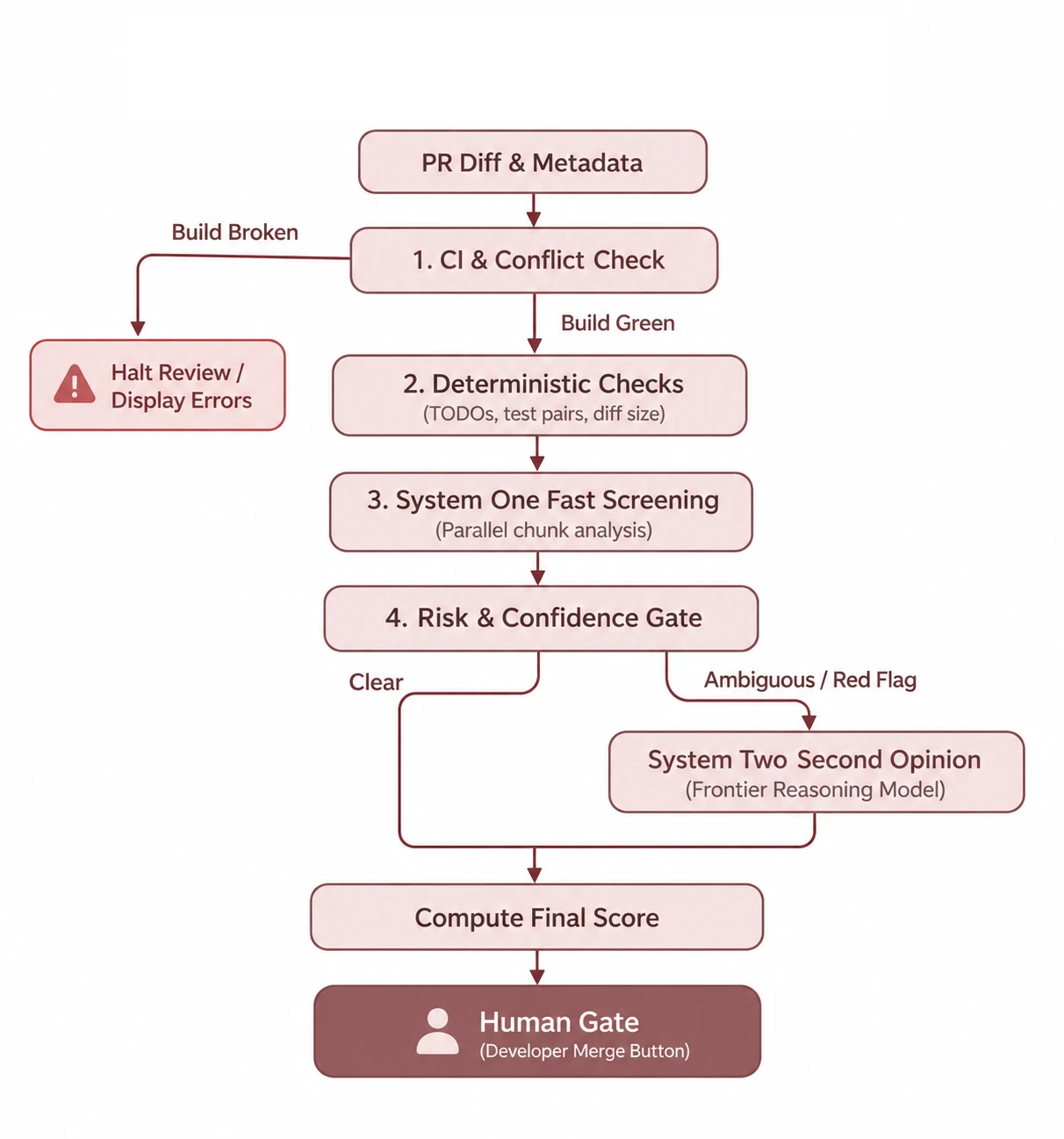
- Code Checks the Basics First: Did CI pass? Are there git conflicts? Does each modified file have a test file? If basic checks fail, no AI is called.
- System One Screens in Chunks: Large diffs are split into manageable chunks. System One evaluates risk flags across chunks in parallel:
has_secrets: Any hardcoded API keys or credentials?is_breaking: Change break an API or schema?modifies_auth: Touch authentication, permissions, or security boundaries?performance_risk: Introduce unindexed queries or heavy blocking loops?matches_ticket: Fulfill the ticket?
- System Two as a Targeted Second Opinion: If System One is unsure or raises a red flag, we invoke a frontier reasoning model to check only that specific question.
- The reasoning model never reads the full PR — only the flagged ambiguity.
- A red flag can drop to “worth a look”, but can never be erased silently.
- Cost profile: A routine PR evaluated cleanly by System One costs about
$0.002. A PR needing a System Two second opinion costs about$0.10.
- The Human Gate: The AI never merges code. It posts an advisory checklist. The developer always presses the merge button.
How It Augmented the Setup
- Sub-Cent Routine Reviews: Between 80% and 90% of everyday pull requests pass review in seconds for a fraction of a cent.
- Deep Deliberation Where It Matters: Frontier reasoning models are invoked only when genuine ambiguity exists, eliminating noisy stylistic commentary.
- Safer Merges: Reviewers get an instant summary of high-risk regions before approving, without waiting on slow pipelines.
Comparison of the Three Mechanisms
| Dimension | 1. The Rule Enforcer | 2. The Candidate Ranker | 3. The First Responder |
|---|---|---|---|
| Input Stream | Role metadata & eligibility rules | RAG-retrieved test cases | Chunked code diffs |
| System One Role | Resolves semantic ambiguity | Classifies test relevance | High-speed risk screener |
| Threshold & Escalation | Auto-veto clear non-fits; Human reviews conflicts | High confidence to Must Run; Human QA confirms selection | Ambiguity escalates to System Two; Human developer retains merge |
| How Setup Was Augmented | Rescued leads missed by rules; cut review queue by 60% | Cut test scoping from 20 mins to 1 click in 1–2s | 80% to 90% of PRs screened for $0.002; deep review on demand |
What We Learned
Running these setups in production made a few things clear:
- Most pipelines need classification, not conversation: In backend software, you rarely want an AI writing paragraphs of prose. You want a fast, typed decision in milliseconds for fractions of a penny.
- Rules and AI work best together: Deterministic rules are fast, exact, and cheap. AI handles the messy ways humans write things. Combining them gives you the speed of code without breaking on slight wording quirks.
- Heavy reasoning is for escalations, not daily traffic: Running slow, expensive models over every single input doesn’t make sense. Use fast System One models for the 90% of routine work, and bring in deep reasoning only when an edge case is genuinely ambiguous.
- Keep humans in control of real actions: An AI judge is great at triaging, scoring, and flagging risks. But whenever an action touches the outside world — sending an outreach email, updating customer records, or merging code — a human should always make the final call.